

Mesh gutter guards are simple in concept. A screen covers the top of the gutter, rain passes through the holes, and leaves and larger debris stay out.
The part that gets oversimplified is the word mesh. A guard with large openings does not perform the same way as fine mesh, and neither performs the same way as stainless steel micro mesh.
If the main problem is broad leaves, standard mesh can work very well. If the gutters fill with pine needles, shingle granules, and other fine debris, a more open screen is usually the wrong choice.
The roof matters too because a mesh gutter guard that handles water well across a straight eave can still struggle where a valley concentrates runoff into one corner. Installation quality changes performance again, which is why homeowners should judge the screen, roof conditions, and installation method together.
How Mesh Gutter Guards Work

Mesh gutter guards create a screen across the open top of the gutters. Water enters through the holes while leaves, twigs, seed pods, and other debris that are too large to pass through stay on the surface.
That keeps material out of the gutter trough, where wet debris would otherwise settle around gutter hangers and downspouts. Over time, that buildup can slow drainage and contribute to overflow.
This is one of the simpler gutter guard technologies because water passes directly through the screen instead of being redirected around a solid gutter cover. The design works well when the mesh openings match the debris falling on the roof.
The Mesh Acts as the First Line of Defense
Without gutter protection, anything that reaches the roof edge can fall into the gutters. A few dry leaves are not usually what causes the problem, but wet leaves can settle into the trough and begin catching twigs, seed pods, dirt, and other debris.
Mesh prevents much of that material from reaching the trough in the first place. Dry leaves may blow off the surface naturally, while heavier material may stay until wind, rain, or routine gutter maintenance removes it.
Either situation is easier to manage than pulling decomposed material from the bottom of the gutter. The screen keeps the majority of larger debris where it is easier to see and remove.
Water Enters Through the Openings
Rain lands on the mesh and moves through the openings into the gutter below. Surface tension can help water cling to the screen as it passes through, but the guard still needs enough open area to accept the runoff reaching that part of the roof.
The angle of the mesh, hole size, and condition of the surface all affect water flow. A clean guard installed correctly can handle water very differently from the same mesh installed too flat or covered with existing debris.
Larger Openings Mean Less Filtration
This is where mesh gutter guards start to separate from one another. Larger holes can block leaves and twigs while letting rain pass easily, but they can also let pine needles, small seed pods, fine roof grit, and shingle granules through.
Fine mesh improves filtration by reducing the opening size. Micro mesh guards take that much further, using very small openings intended to stop material that standard mesh cannot.
The best choice depends on what actually lands on the roof. A screen should be selected for the debris around the property rather than because it has the smallest holes available.
What Mesh Gutter Guards Keep Out

Traditional mesh is at its best with larger debris. Broad leaves, small branches, twigs, and many seed pods are easy for a screen to stop because they are much larger than the holes.
That makes mesh a sensible form of gutter protection for plenty of homes. Problems usually show up when the debris is narrow enough or small enough to fit through the guard.
Leaves and Twigs Are Usually Easy to Stop
Broad leaves are not particularly difficult to block. They hit the screen and stay above the gutter instead of dropping into the trough.
When the leaves dry, wind may clear much of the surface without any work from the homeowner. Twigs behave much the same way unless they are small enough to lodge in the holes.
For a property surrounded mainly by broadleaf trees, traditional mesh can provide effective gutter protection without requiring extremely small openings. In that situation, a basic screen may be all the filtration the home actually needs.
Pine Needles Are Different
Pine needles are where standard mesh often falls short. A pine needle does not need an opening as wide as its full length because it can fall vertically through a screen or work through at an angle.
Once enough pine needles reach the gutters, they begin tangling together. That layer can catch dirt, small seeds, and other fine debris until material starts collecting around the downspouts.
If pine needles are the recurring reason a homeowner cannot keep clean gutters, a coarse mesh is usually not enough. Finer micro mesh gutter guards are designed for exactly this type of debris because the openings are too small for most pine needles to pass through.
Shingle Granules and Fine Roof Grit May Pass Through
Standard mesh is also not meant to stop every small particle coming off the roof. Shingle granules, fine roof grit, dirt, pollen, and similar material can fit through larger mesh holes.
Over time, some of that material may settle in the gutters even though leaves are being kept out. That does not automatically mean the guard failed because the screen may be filtering exactly according to its opening size.
A screen should be judged by what it was designed to block. If the holes are clearly larger than the fine debris landing on the roof, some of that material will enter the gutter.
Seed Pods Can Go Either Way
Seed pods are a good example of why opening size needs to match the property. Large pods stay above most mesh easily, while tiny seeds or narrow pieces can pass through.
This is why two neighbors can install similar-looking leaf guards and have very different experiences. Their trees may be producing completely different debris, even if the gutters themselves look almost identical.
Mesh Opening Size Is the Biggest Performance Difference

Most homeowners comparing gutter protection systems spend too much time looking at the brand name and not enough time looking at the screen. The holes tell you a lot about how the guard is likely to perform.
If the openings are large, the guard is primarily stopping larger material. If the openings are fine, it will filter more, and true micro mesh can keep out pine needles and much smaller debris.
Standard Mesh Works Well for Coarse Debris
A traditional mesh screen does not need tiny holes to block leaves. In fact, a relatively open mesh can be a very practical choice when leaves and twigs are the main problem.
Rain has plenty of places to enter, and the debris is far too large to get through. That simplicity can work extremely well on the right house.
There is no reason to chase maximum protection against fine particles if the property does not produce fine debris. More filtration only helps when there is actually something smaller that needs to be filtered.
Fine Mesh Improves Filtration
Fine mesh reduces the opening size without necessarily going all the way to a true micro-mesh screen. That can improve filtration against small seeds and narrow debris while still keeping the basic screen-style design.
It is a useful middle ground on properties with mixed vegetation. The mistake is assuming “fine mesh” guarantees a particular level of filtration because mesh size varies between products.
Look at the actual openings and the material instead of relying on the label. Two products sold as mesh gutter guards may allow very different debris through.
Micro Mesh Is Better for Pine Needles
If the roof regularly collects pine needles, micro mesh has the practical advantage. The smaller openings make it much harder for needles to pass into the gutter.
Steel micro mesh and stainless steel micro-mesh are common approaches because metal can maintain very small openings without relying on a plastic screen. Micro mesh also does a better job with shingle granules, fine roof grit, and other fine debris.
If that is the problem the homeowner is trying to solve, choosing a more open mesh usually means accepting debris that the finer screen could have stopped. For a closer look at the difference, see Micro-Mesh Gutter Guards: How They Work and Why They’re Effective.
The Smallest Holes Are Not Automatically the Best Choice
Filtration is only one part of performance, and a very fine screen still has to accept the water coming off the roof. Downspouts have to keep up, the gutters need the correct pitch, and valleys and corners need enough capacity for concentrated runoff.
More restrictive filtration can produce enhanced performance against pine needles while placing more importance on the design and installation of the guard. The debris and the roof have to be considered together.
Water Flow Depends on More Than the Mesh
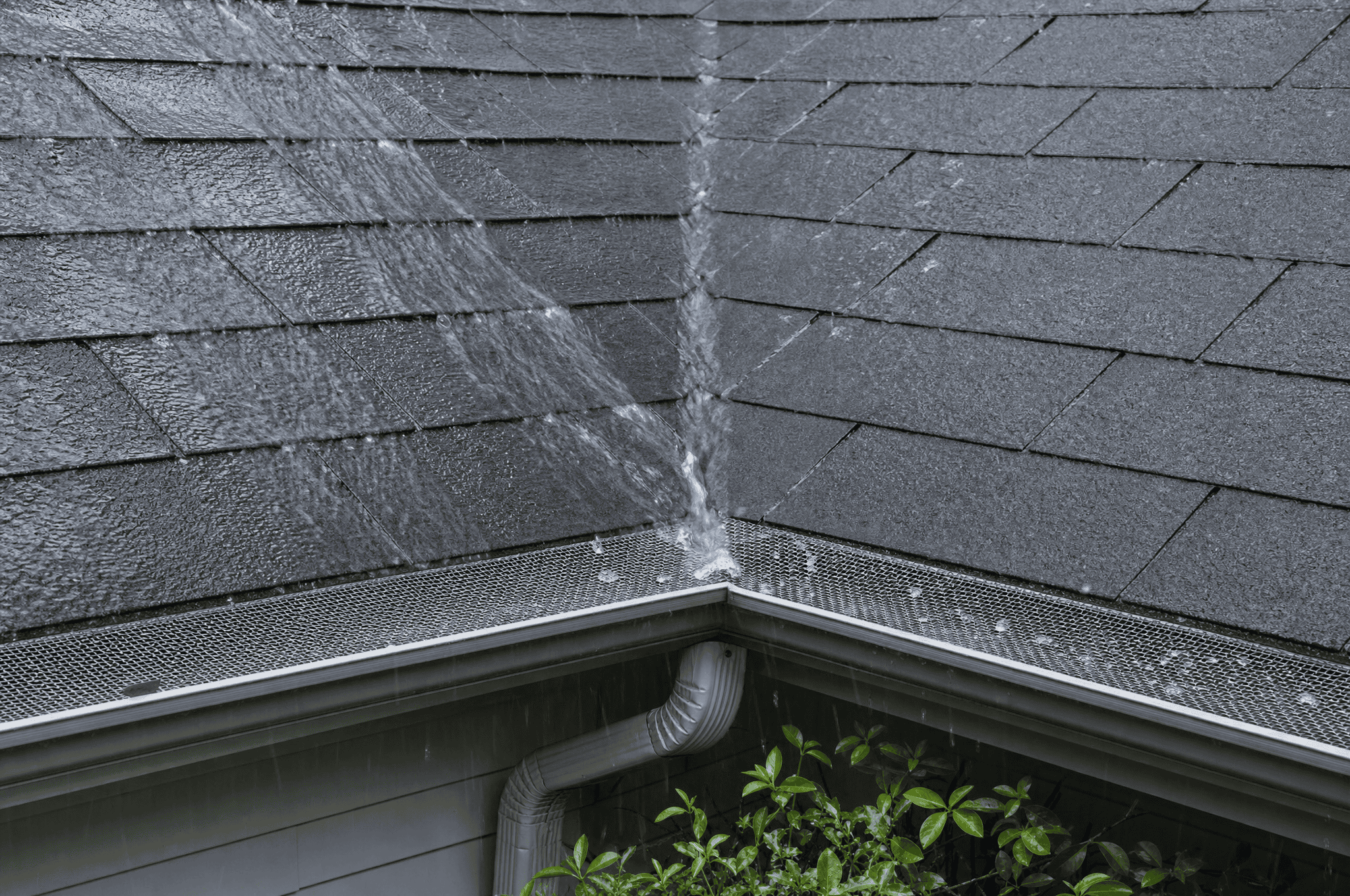
A mesh guard can have plenty of holes and still overflow if the water does not reach those holes properly. That often shows up during heavier rain rather than an ordinary shower.
The roof pitch, guard angle, gutter lip, downspout layout, corners, and amount of water reaching one section all affect how the system behaves. A screen that performs well in one section of roof may behave differently in another.
The Screen Has to Sit Correctly
The mesh should be positioned so water can move through it instead of skating across the top. A guard installed too flat, too high, or at an awkward angle near the roof may send water toward the front edge even when the mesh itself is clean.
If water repeatedly runs over the front lip, do not immediately assume the holes are too small. The installation method may be the real issue, or the gutters may be struggling with the amount of runoff reaching that section.
Roof Valleys Concentrate Water
Roof valleys are a common trouble spot because they can send a lot of water toward a very small section of gutter. A long straight eave spreads runoff across many feet of mesh, while a valley can send water from two roof planes into the same corner.
That is where the guard’s performance aspects become much easier to judge. If the mesh sits too flat at the valley, the nearest downspout is too far away, or the gutter already struggles with water volume, overflow may show up there while the rest of the system performs normally.
Corners should be evaluated as their own conditions instead of being treated like another straight section. The roof layout can matter just as much as the screen itself.
Downspouts Still Determine How Fast the Gutter Drains
The guard only gets water into the gutter. After that, the gutters and downspouts need to move it away from the home.
Existing debris inside a downspout can cause overflow even if the mesh is perfectly clear. Poor pitch can leave standing water in the trough, and a gutter that already struggles during storms will not suddenly gain capacity because a screen was installed above it.
Gutter protection works best as part of a functioning drainage system. The guard keeps debris out so the rest of the system can do its job.
Guards Help Reduce Water Problems, but They Are Not a Cure-All
Keeping leaves out of gutters can reduce the chance of clogs that send water over the edge. That can help protect landscaping and reduce water dumping near the home’s foundation.
Guards do not fix every source of water damage, though. Improper grading, inadequate downspouts, roof drainage problems, and other conditions still need their own solution.
Mesh guards are a proactive step in keeping debris from interfering with drainage. They should not be treated as a replacement for the rest of the roof and gutter system.
Mesh Gutter Guards vs. Micro Mesh Guards

Traditional mesh and micro mesh work on the same basic principle. Both allow water to enter while trying to prevent debris from reaching the gutter.
The difference is filtration. Traditional mesh is usually better described as protection against leaves and larger debris, while micro mesh is designed to catch much smaller material.
Standard Mesh Uses Larger Holes
A standard screen can block leaves and twigs very effectively while maintaining plenty of open area for water. That is enough for many homes where fine debris is limited.
If the roof is not surrounded by pine trees, traditional mesh may perform exactly as expected. It becomes a weaker choice when the problem material is smaller than the openings.
No installation technique can make a large hole block a pine needle that physically fits through it. The size of the debris has to match the size of the screen opening.
Micro Mesh Guards Improve Filtration
Micro mesh uses much smaller holes, which means better filtration against pine needles, shingle granules, fine roof grit, and other small material. Many higher-filtration systems use stainless steel micro mesh supported by an aluminum or steel frame.
The strength of the frame matters because the mesh needs to stay in position through temperature changes, debris loads, and weather. Finer filtration is a real advantage, but it is not a reason to ignore construction quality.
Micro Mesh Still Needs Water Capacity
A finer screen does not get a free pass on water handling. Micro mesh systems need enough surface area and the right profile to move water through the openings before it reaches the edge.
Some products use shaped frames or trough technology intended to keep water moving into the gutter. Others rely on fine mesh stretched across a relatively straightforward support.
Either design can work if it is matched to the roof and installed correctly. The guard still has to handle the actual volume and direction of runoff coming off the roof.
Both Types Need Maintenance
Mesh and micro mesh both keep debris above the gutter instead of making debris disappear. Wind and rain can shed some of that material naturally, but leaves, pine needles, pollen, and dirt can still remain on the surface.
A finer screen may catch more of the material that would otherwise pass through, which means surface condition becomes even more important. No guard should be sold as a maintenance-free roof accessory.
Material Matters More Than It Looks From the Ground

From the yard, gutter guards can all look like a dark strip across the gutter. Up close, construction varies considerably.
You may see aluminum mesh, plastic screening, stainless steel micro mesh, steel frames, or combinations of several materials. Those choices affect how the guard holds its shape and handles years of exposure.
Aluminum Mesh Is Common for Standard Guards
Aluminum mesh is lightweight and naturally resistant to rust. It works well for traditional gutter protection when the openings match the debris and the screen is supported properly.
Very thin aluminum can deform more easily, especially around gutter hangers or corners. If the material bows, the back edge and front edge may no longer sit where they were intended.
The screen does not need to be extremely heavy, but it does need enough structure to remain in place. A guard that shifts or sags can create gaps that let debris into the gutter.
Stainless Steel Makes Sense for Micro Mesh
Very fine screening benefits from stainless steel because the material can maintain small openings while resisting corrosion. You will often see stainless steel micro mesh paired with an aluminum or steel frame.
Some well-known retail products, including Raptor Gutter Guard, use stainless steel micro-mesh. That construction is part of why Raptor Gutter Guard frequently appears when homeowners research fine-mesh systems.
The useful takeaway is not that one named product should automatically be selected. The material and frame construction should make sense for long-term exterior exposure.
A stainless steel micro screen attached to a weak frame is still a weak system. The screen and support need to work together.
Steel Frames Can Add Rigidity
Some gutter protection systems use heavier steel framing to support the screen. That extra rigidity can help the guard maintain its profile through snow, wet leaves, temperature cycling, and normal roof-edge movement.
Exact gauge and construction vary by manufacturer, so homeowners should not assume all steel-framed products are built the same way. Ask to see what is actually being installed and how the mesh is attached to the frame.
Plastic Has More Long-Term Questions
Plastic mesh can prevent debris from entering gutters, but it has more long-term exposure concerns than a well-built metal system. Sunlight, temperature swings, snow, and repeated heating and cooling can make some plastics brittle or distorted over time.
This does not mean plastic fails immediately. It means UV exposure and temperature cycling deserve consideration on a component expected to stay outdoors year after year.
All-metal construction removes that particular concern. It still needs sound design and proper installation to perform well.
Gutter Guards Do Not Prevent Ice Dams
Mesh gutter guards can handle winter exposure when the materials and installation are appropriate, but they do not prevent ice dams. Ice-dam formation involves roof temperature, insulation, ventilation, snowmelt, and freezing at the roof edge.
Adding a screen to the gutter does not correct those conditions. Homeowners should not choose a gutter guard based on a promise that it will solve a roofing or attic problem it was never designed to fix.
Installation Quality Has a Huge Effect on Mesh Gutter Guards

A sturdy mesh installed over sagging gutters, a blocked downspout, or damaged fascia board is not going to perform well. Neither is a good screen left with gaps at the corners or forced under shingles in a way the product was not designed for.
Professional gutter guard installation should begin with the existing gutters, not with opening the box of guards. The underlying drainage system needs to work before it is covered.
Existing Gutters Need to Be Clean and Working
Guards should not be installed over leaves, mud, or other existing debris. The gutters should be cleaned first so the installer can see the condition of the trough and test how water moves through the system.
Look at the gutter pitch, seams, downspouts, gutter hangers, and fascia board. If a section sags or holds water, fix it before the guard goes on.
If a downspout is already clogged, clear it first. Putting gutter guards over a drainage problem simply hides the problem.
Gutter Hangers Affect How the Guard Sits
Many modern gutters use hidden gutter hangers inside the trough. Depending on the guard design, those hangers can affect how flat the mesh sits or where it can be secured.
A professional installer accounts for the hardware instead of bending the guard around it or leaving sections loose. Uneven support can create gaps and change water flow across the surface.
The Front Edge and Back Edge Need to Fit Cleanly
Mesh guards should cover the gutter without leaving a path for debris to slip underneath. How that happens depends on the product.
Some systems attach near the front lip and back edge of the gutter. Others interact with the roof edge or first course of shingles, while some sit below the drip edge without disturbing the roofing materials.
Not every product installs the same way. The manufacturer’s installation instructions should control where the guard is fastened and how it relates to the shingles.
Roofing materials should not be lifted, pierced, or altered simply because that makes the guard easier to fit. A clean installation respects both the gutter and the roof.
Corners Usually Show the Quality of the Work
Straight sections are easy, while corners take more thought. Inside corners, outside corners, roof valleys, and transitions may require the mesh to be cut and shaped so the pieces meet without large gaps or bulky overlaps.
Metal guards are often trimmed with tin snips or similar tools. Section lengths need to be measured before cutting so the pieces fit cleanly.
Hardware matters too because some manufactured guards come with included screws or specific fasteners intended for that product. Steel gutters may require different fastening or pre-drilling than aluminum gutters.
Those details belong in the installation process, but homeowners should not have to become installers themselves. They should be able to look at the finished work and see secure, clean-fitting sections without obvious gaps.
Product-Specific Instructions Matter
Retail mesh products often publish detailed installation requirements. For example, Raptor Gutter Guard is a stainless steel micro-mesh product commonly sold for standard residential gutters, and its installation instructions and included screws are specific to that system.
Those details should not be copied onto a different guard. The same applies to fitting claims because a guard advertised for a standard 5-inch gutter does not automatically fit larger gutters, half round gutters, or every custom profile.
Treat manufacturer instructions as product-specific, not universal gutter guard instructions. Installation quality matters more than simply following a generic set of steps.
K Style and Half Round Gutters Need Different Fits
Most residential guards are easiest to find for K style gutters because that profile is so common. Half round gutters have a different front edge and different geometry.
A guard designed around a K style gutter lip may not attach securely to a half round gutter. Hangers can also interfere differently because of the rounded trough.
A screen being wide enough does not mean it is compatible. When homeowners have half round gutters, the contractor should confirm the guard and installation method before ordering materials.
Mesh Gutter Guards Still Need Maintenance

Mesh gutter guards reduce how much material reaches the trough, so they can reduce the amount of traditional gutter cleaning a home needs. They do not produce permanently clean gutters.
The surface is still outside collecting whatever the roof collects. Leaves, pine needles, dirt, and other debris can remain on the screen even when the gutter underneath stays relatively clear.
Some Debris Will Stay on the Mesh
Dry leaves may blow away, but wet leaves can stick to the screen. Pine needles can lodge in larger holes, and dirt, pollen, and fine debris can settle where water runs repeatedly.
Specific environmental factors make a big difference here. A roof under dense tree cover will need more attention than a roof surrounded by open space.
Areas below valleys often collect more material because water keeps moving debris toward the same section. That is normal gutter maintenance, not necessarily a sign the guards are failing.
Watch How Water Behaves
You do not need to inspect every hole to know when something has changed. Watching the gutters during rain can tell you more than looking at them on a dry day.
If water begins running over the front lip in an area that previously drained well, check the mesh surface. If the surface is clear, look farther down the system.
The problem may be a blocked downspout, debris underneath the guard, poor gutter pitch, or more water reaching that corner than the system can manage. Diagnosis should come before replacement.
Pest Protection Is a Secondary Benefit
Covering an open gutter can also make it harder for larger pests and nesting material to get into the trough. That is useful, especially when debris and standing water have made the gutters attractive to insects or small animals.
Pest protection should still be treated as a secondary benefit. The main job of a mesh gutter cover is to prevent debris from interfering with water drainage.
When Mesh Gutter Guards Are the Right Choice
Traditional mesh gutter guards make sense when leaves, twigs, and other larger debris are causing the clogs. They are much less convincing when the property drops pine needles heavily.
If the holes are larger than the debris you are trying to stop, the screen is not going to suddenly improve because it has a nicer frame or more screws. That is the point where fine mesh or micro mesh becomes the better gutter protection strategy.
The condition of the house matters just as much. Existing gutters need to drain properly, downspouts need to be clear, roof valleys and corners need to be considered during installation, and half round gutters need guards built for their profile.
Homeowners comparing different gutter protection systems should also understand that foam works very differently from a screen. See Foam Gutter Guards: Pros, Cons, and Better Alternatives for that comparison.
Mesh works when three things line up: the holes are small enough for the debris, the gutter system can handle the roof water, and the guard is installed correctly. When those conditions are met, a mesh screen can provide dependable gutter protection without pretending to solve problems that belong somewhere else on the roof.